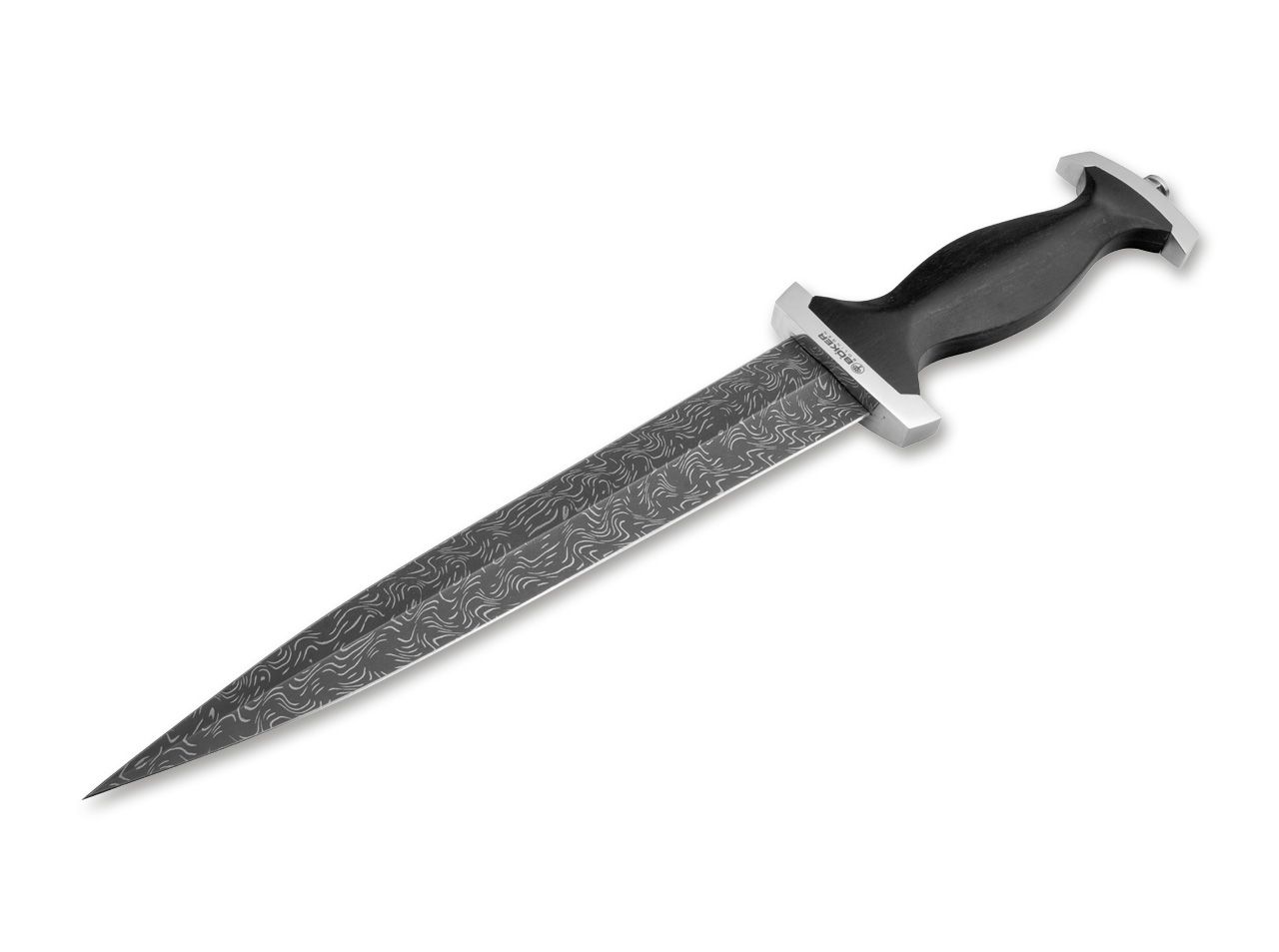
Product information "Swiss Dagger Mosaic Damascus"
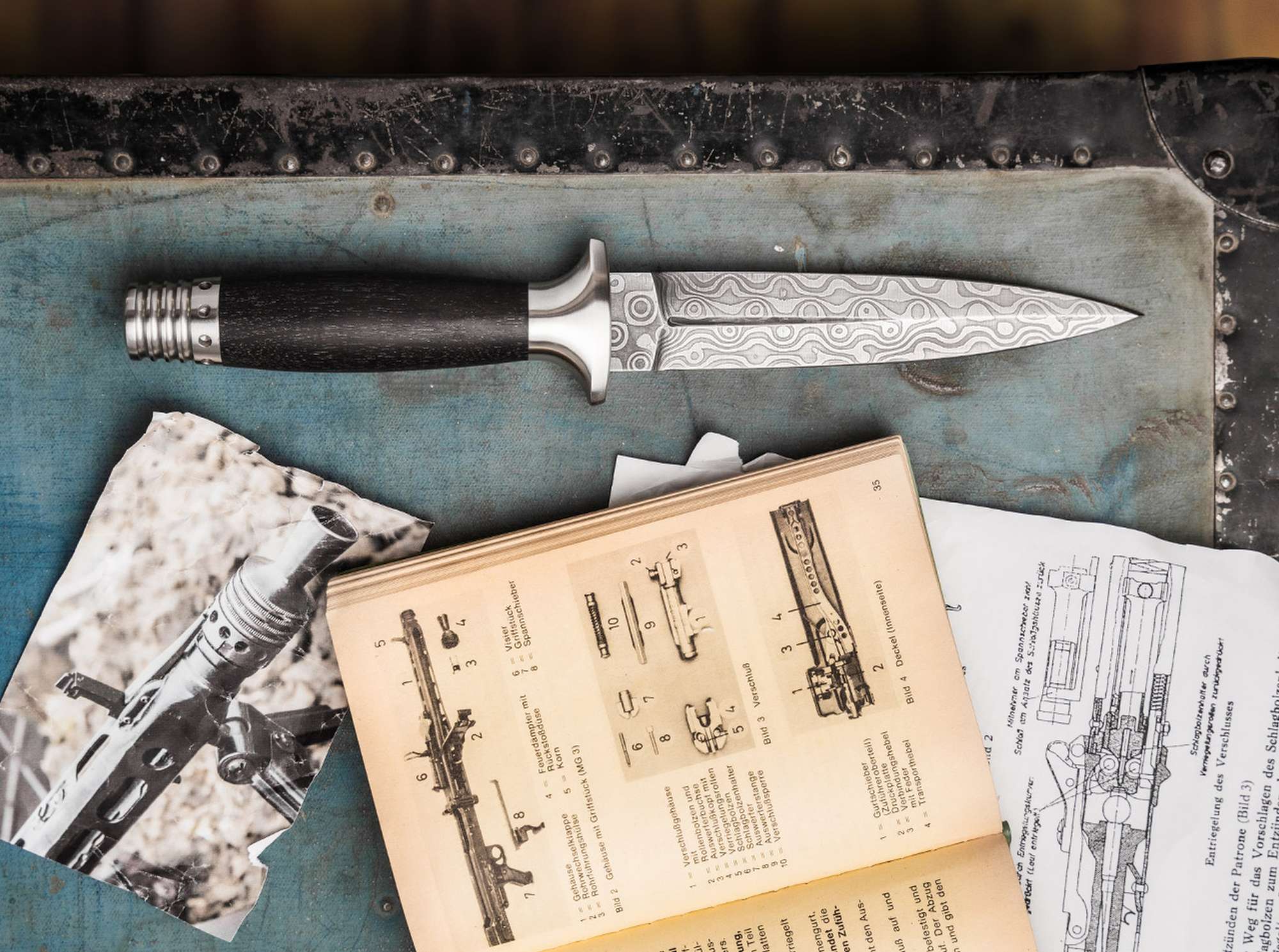
As early as the 15th and 16th centuries, the Swiss dagger was used as a common weapon by Swiss pikemen and, due to its blade length, often occupied a middle position between dagger and sword. The dagger, also known as a baselard, usually served as a secondary weapon and was usually not issued as equipment, but had to be procured privately by the soldiers.
The extraordinary Twisted Damascus is now followed by the Mosaic Damascus, which is also very complex to manufacture. It is one of the royal class of Damascus forging and makes the impressive dagger an absolute highlight in every knife collection. In contrast to conventional Damascus, no layers are produced in the manufacture of Mosaic Damascus. Instead, complex Damascus bars are forged by hand into a mosaic in an elaborate and very complicated process. To do this, the Damascus package, which initially consists of stacked layers, is cut up and reassembled in a staggered manner to create a unique mosaic pattern at the end faces of the bar. The Damascus is then cut up again and the complex process is repeated several times, the resulting pattern becoming finer and more unique with each step. Finally, the individual packages are stacked and forged in the shape of a square so that the ends of the individual pieces form a new surface. Forging temperature, forming, deformation rate and the previous steps must be optimally coordinated. This extremely demanding forging process, which only few Damascus smiths master, is carried out to perfection for our Swiss dagger by Chad Nichols.
The dagger blade, sharpened and pointed on both sides, already had a diamond-shaped cross-section in historical models, because this construction proved to be extremely stable and effective. Characteristic of the Swiss Dagger is the design of the pommel and the crossguard. The unusual, curved design can be traced back to the early 13th century and can also be found in the authentic design of our hand-made edition. The shimmering dark handle made of hand-picked certified imported Ebony is bordered by the highly polished pommel and the crossguard and forms a perfect unit with the fine blade.
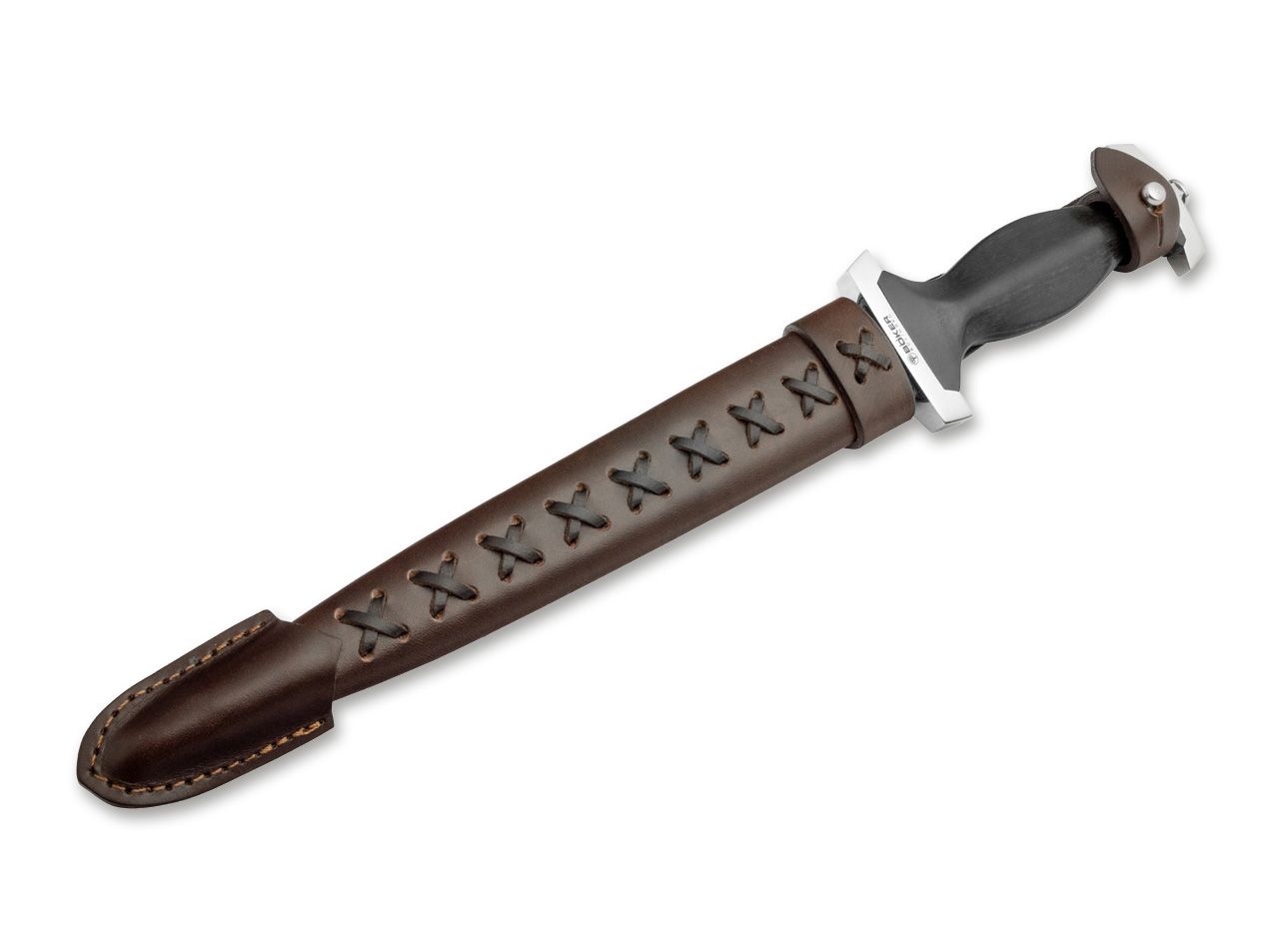
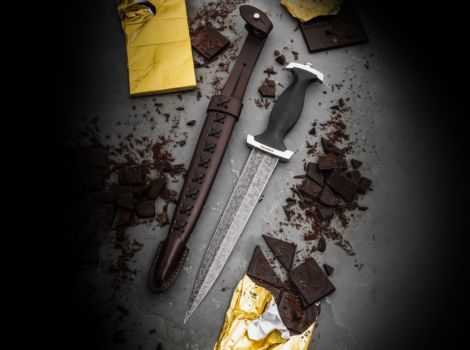
The leather sheath, specially designed and handsewn for this model, underlines the exclusivity of this coveted collectors item. It is delivered with an individual serial number in a noble wooden box and with a certificate of authenticity. Handmade in the Boker Knife Manufactory Solingen and strictly limited to 500 pieces worldwide.
0 of 0 reviews
Leave a review!
Share your experiences with other customers.
Login
No reviews found. Be the first to share your insights.
With the classically elegant Boker MG-42 Damascus Dagger, the crown of historical Boker Damascus steel projects is provided with yet another jewel. The MG-42 is one of the internationally renowned milestones in weapons technology, thanks above all to its revolutionary production technology at the time with the consistent use of stamped sheet metal parts, exceptional reliability and ease of use, and a cadence that was previously unknown.Raw materials and production time had increasingly become critical and decisive factors in the course of the war. Therefore, the Army Ordnance Office was looking for a successor to the MG-34, which was already convincing in its function, but took up too much time and material due to its complex production. The new MG was also to serve as a standardised weapon for light, anti-aircraft, airborne and aperture purposes. Since the central task was not to improve the product but to optimise the manufacturing process, a proven specialist in mass production rather than a weapons expert was commissioned with the new design. The choice fell on Werner Gruner, a mechanical engineer at the Johannes Großfuß metal and lacquerware factory. Gruner was presumably assisted in the development by experienced gun designers. The consistent use of sheet metal stampings instead of milled parts and the omission of accurateness in non-functional details made it possible to build a weapon that was even more reliable than its predecessor, while significantly reducing production time and costs. Almost trouble-free function and firing accuracy in all weather conditions, the change of hot-shot barrels within seconds and a cadence of 1,500 rounds per minute (25 rounds/second) established the MG-42's reputation. A brake in the form of additional mass in the breech cavity made it possible to reduce the immense cadence to 700 rounds/minute and thus the ammunition consumption. A roller shutter controlled by a cam made these impressive technical characteristics possible. In a slightly modified form, the MG-42 is still the standard MG of the German armed forces today as MG 3. Rare originals from the Second World War fetch between USD 40,000 and USD 60,000 at Rock Island Auctions.The steel of the MG-42 is forged by our long-time and experienced partner Chad Nicols into the heart of the dagger, the double-edged blade with a discreet hollow groove on both sides. The chosen Damascus pattern, Low Layer Raindrop (40 layers) is excellently accentuated by the symmetrical profile of the blade.The dagger's toggle and pommel are made of solid stainless steel. In the pommel, the cooling fins and gas outlets of the recoil amplifier (actually a combined component with the functions of a recoil amplifier, a flash hider and a barrel guide sleeve) were incorporated as a design element. Nevertheless, form followed function here as well, for the grooves increase the grip of the dagger in the reverse grip. The toggle and pommel joinlessly hold the barrel-shaped roll of polished desert ironwood, which is automatically centred in the hand by its shape. The dagger is equipped with a high-quality sheath made of dark brown leather with a belt loop and place reinforcement. Supplied with a classy frame case for seemingly floating presentation, certificate of authenticity and individual serial number.
Details:
Overall length: 25,4 cm
Blade length: 13,5 cm
Weight: 195 g
Blade thickness: 5,0 mm
Blade material: Damast
Handle material: Wüsteneisenholz
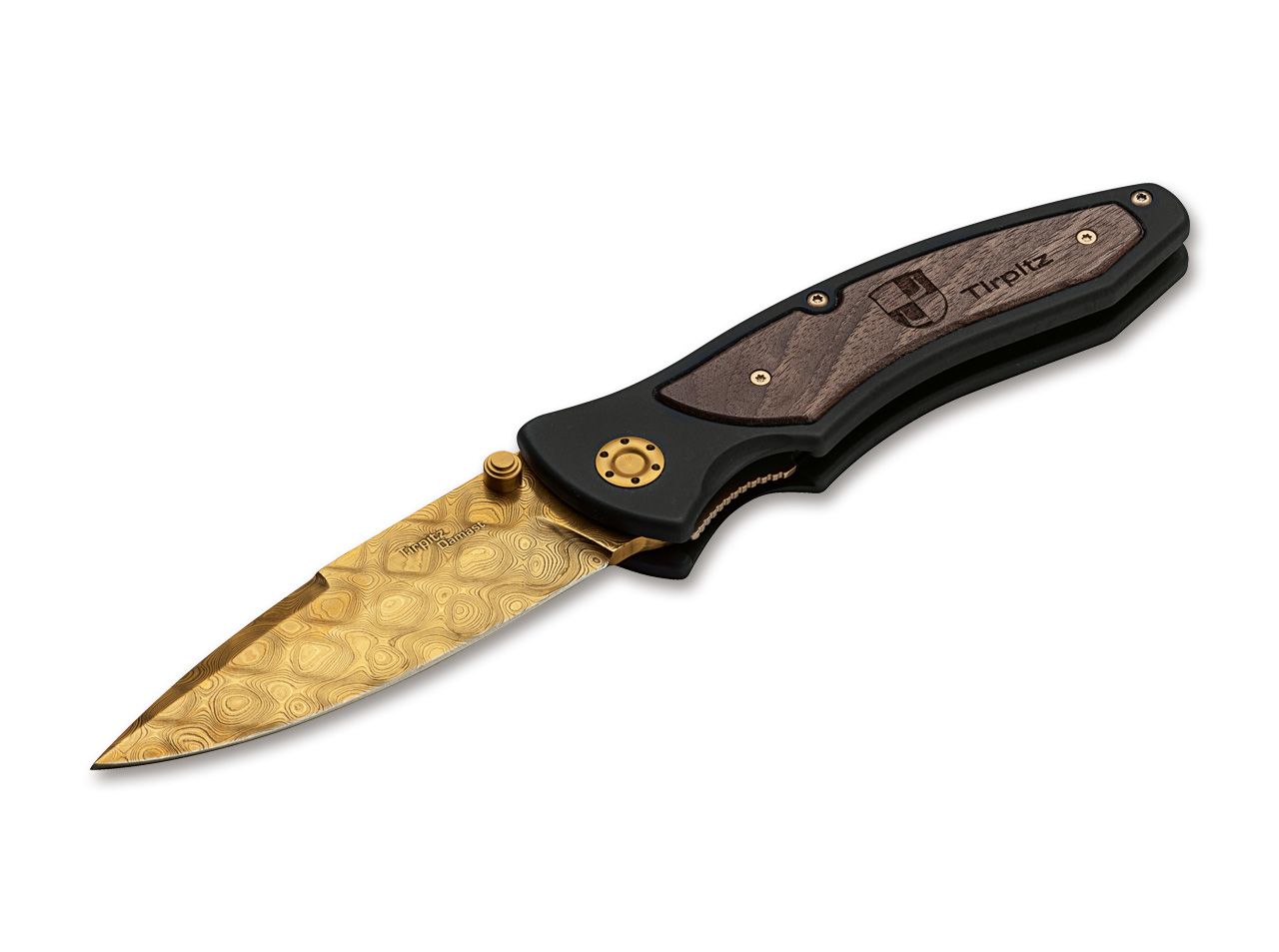
On April 1, 1939, the Tirpitz, named after Fleet Admiral Alfred von Tirpitz, was christened and launched in Wilhelmshaven. Since then, a larger battleship has never been built again in Europe. Now, 80 years later, we are presenting the special edition Boker Tirpitz-Damascus Gold as a reminder that Western Europe suffered through two World Wars and has been living in peace and liberty since 1945. In memory of the countless victims of those wars especially the crew of the Tirpitz we are donating 10 per sold knife to the German military graves commission.The enormous battleship was sunk in 1944 off the Norwegian coast. Right after the end of World War II, a Norwegian company sent experts to salvage the ship's wreck, in order to make the highly alloyed steel available for civilian purposes. Boker received some parts of the salvaged armoring of the Tirpitz. Our Damascus blacksmith took these pieces of living history and forged an exclusive and exceptional steel with a fascinating history.At first glance, the Boker Tirpitz-Damascus Gold fascinates with its peerless Damascus blade, exclusively plated with gold. The blade consists of 300 layers of hand-forged Tirpitz-Damascus with the "Great Pyramid" pattern. The subtle sheen of the gold plating catches the eye of the beholder. All elements such as thumbstud, blade and handle screws, spacers, liner, clip and replacement clip plate are gold-plated as well. The blade is secured with a 1.5 mm thick linerlock.The repositionable clip (tip-up/tip-down) allows for convenient carry options. The inlay of domestic walnut wood sports the coat of arms and name of the Tirpitz. Each knife of this special edition is an elegant combination of history, remembrance and modern technology. Completely handmade by Boker in Solingen. It comes in a frame case with an individual serial number and a certificate of authenticity.
Details:
Overall length: 22,9 cm
Blade length: 9,9 cm
Weight: 180 g
Blade thickness: 3,5 mm
Blade material: Damast
Handle material: Aluminium
Lock: Linerlock
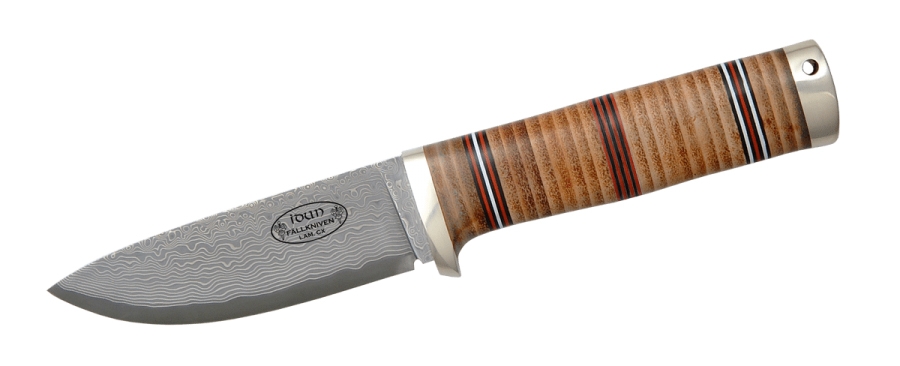
It is our pleasure to present one of the world’s most advanced hunting knives – NL5cx Idun, with a blade in Cowry X Damascus steel. This is probably the world’s best edge steel, all categories, and definitely one of the most exclusive blades ever made. The edge comprises a powder steel with the following extreme content: C 3%, Cr 20%, Mo 1%, V 0.3% and iron to 100%. Its hardness is no less than 64 HRC! The sides consist of stainless, 120-layer Damascus steel, and with the edge of powdered steel, we have formed a blade which in its beauty and strength is world class, no less. The knife is an excellent utility to all, but probably most customers will acquire it for its exclusive collectability.The handle consists of specially selected oxhide: sadly a material that is usually overlooked by manufacturers, but which gives a sure and rugged grip. It ages beautifully and as the years pass it acquires an attractive brown patina, and it is unaffected by oil and solvents and impervious to water. Dryness might cause small cracks on the handle but they disappear when the knife is put to use again.We are persisting with the convex edge, since we consider this to be the ultimate combination of cutting performance and edge strength, and of course our NL5 Idun knife features this. Anyone who knows anything about knife making knows that such an edge can only be made by hand, and that’s why 99.99% of all knives don’t have that kind of edge. Knives in general are of course mass produced, where CNC (Computer Numerically Controlled) robots and grinders shape the blades as best they can. The machines are loaded with stacks of blades so that production can go on 24 hours a day and the result is quite often really good – good knives at affordable quotes. However, if you want top-drawer strength, corrosion-resistance, edge durability and design, the machine hasn’t been made that can come even close to the craftsmanship of a trained, skilled knifesmith. Therefore, we take great pride in being able to present our Northern Light Series, well aware that only the most quality-conscious will appreciate its assets.The sheath is made of black high quality leather.
Blade Steel: Cowry X
Hardness (HRC): 64
Sheath: Leather
Weight (knife): 180 grams
Handle material: leather
Blade length: 10 cm
Blade thickness: 5 mm
Total length: 21.5 cm
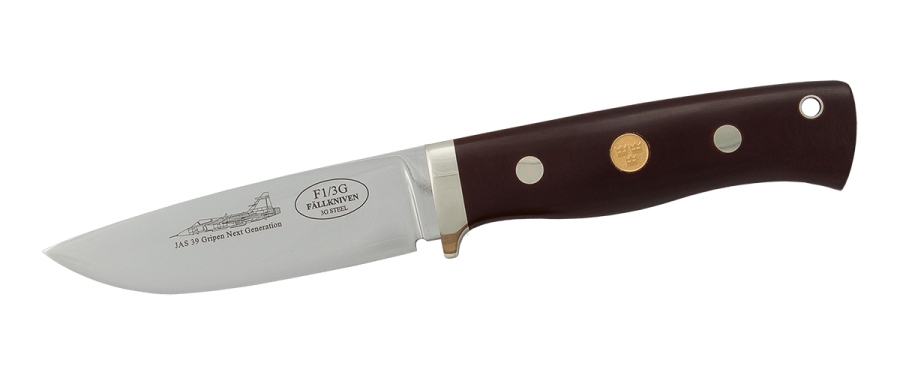
2017 year special model of the F1/3G with maroon or black Micarta is really a very special edition, here are for the first time a distinct, detailed laser engraving of the JAS 39 Griffin NG (Next Generation) along with the traditional oval logo that has been Fällkniven’s hallmark for more than twenty year. The handle medallion in nickel silver is covered with about 30 my thick layer of 24k gold, usually you use 2-3 my only. Guard, tubular rivet and handle rivets are made in nickel silver on this exquisite full tang knife. The knife comes with an all-black leather sheath in a neat wood gift box. How many the final edition will be is yet to be decided but the first samples of only about a hundred pieces of each kind emerges in spring/summer 2017. The reason why the edition is as small as a hundred pieces is because the knife, in a true Loveless design, is made entirely by hand. The blade is made of our best steel, a powder steel, which we call 3G, a vanadium-molybdenum steel that holds an edge very well – of course, the blade has a convex edge, something that we are alone in the world to offer. Although the knife is primarily sold as a collectible, customary value is at least just as high – all our knives are designed to be fully operational, and that really applies on the current F1/3Gmm and F1/3Gbm.The first outlines of our bestseller F1 saw the light in 1987, that is to say, 30 years ago. Our company had been tasked by FMV/Aerospace to develop a new survival knife for the Swedish military pilots, a truly exciting project. We started with the purchase of numerous knives in a certain size range, a premise was that the knife would be accommodated in the leg pocket on the pilots’ clothing. It would be strong, stay sharp, have an ergonomic, comfortable shape, workable with both wet and frozen hands. You would also be able to split wood, use it for surgery injury in the field and work in battle, to name a few desirable properties.An impossible task?We started with field-testing a large number of knives, both sheath- and folding knives, the vast majority of well-known, reputable manufacturers from USA, Europe and Japan. Curiously, none measured up! The bottleneck was the Swedish winter, which set the limits of what was possible. Regarding folding knives we found that they were too weak and not reliable enough, especially when it came in snow, ice or dirt in the locking mechanism. Sheath knives appeared that they had cooling metal details in the handle or that they caused blisters, or were designed in a way that they did not provide an enough secure grip.In that situation, I sat down and began to set up the parameters for how a survival knife for pilots would look alike and, that was a real challenge. The reason why the knife should be light was because if the knife was too heavy it would tear the fabric of the leg pocket in pieces if the pilot was forced to eject from a crashing plane, it’s all about big G-forces. While it in the same time would still be both strong and stay sharp well.It became a hunting knife!As a hunter, I knew how the knife would appear to be safe in your hands even if they were bloody, sweaty or had cold or wet fingers. I solved the edge retention by using a high-alloy corrosion resistant special steel from Hitachi Metal Corp. in Japan, a steel that the Boeing plant used for rotor blades in its huge aircraft engines. As usual, such ideas came from knife makers in the US, where especially the now late Robert W. Loveless, the world’s all-time best knife maker, was the one that drove the development of finer steel knives. I had the pleasure to talk with him in 1997 and he could, among other things, tell me that he had seen an F1 knife and liked what he saw, as he put it. I asked from where he got his inspiration when designing his knives and, to my surprise, he told me that it came from Scandinavia! The answer surprised me but he said he always had liked the simple, clean lines of Scandinavian knives and that that had been the guiding star of his production. Bob Loveless died in September 2010, 81 year old, but his design will live for a very long time – he is considered to be the one who introduced the drop point design of knives, a design which hunters appreciate very much.In August 1995, Fällkniven AB could deliver several thousand knives to the Swedish Air Force. During the following year the knife was introduced to the civilian market, and it led to a viral success. As a result, we discontinued the sale of other brands and focused on designing, developing, manufacturing and selling our own products only. The F1 Pilot Survival Knife was the first production sheath knife in the world fitted with blades made of special steel and that appeared to be very attractive twenty years ago. The F1 blade has through the years been upgraded in terms of the technical content but the original design stands up yet. You really have to search for a more popular knife, a winning concept that this should never be changed. The experience and the philosophical concept that F1 knife is based on can be found in virtually all other knife models from Fällkniven AB, the relationship between the different models is striking, especially in the technical and ergonomic purposes.
Blade Steel: 3G
Hardness (HRC): 62
Sheath: Leather
Weight (knife): 200 grams
Handle material: Maroon Micarta
Blade length: 10 cm
Blade thickness: 4.5 mm
Total length: 21 cm
Coating: satin finish
€599.01*
Dieser Artikel hat eine Lieferfrist von ca. 3-4 Wochen.
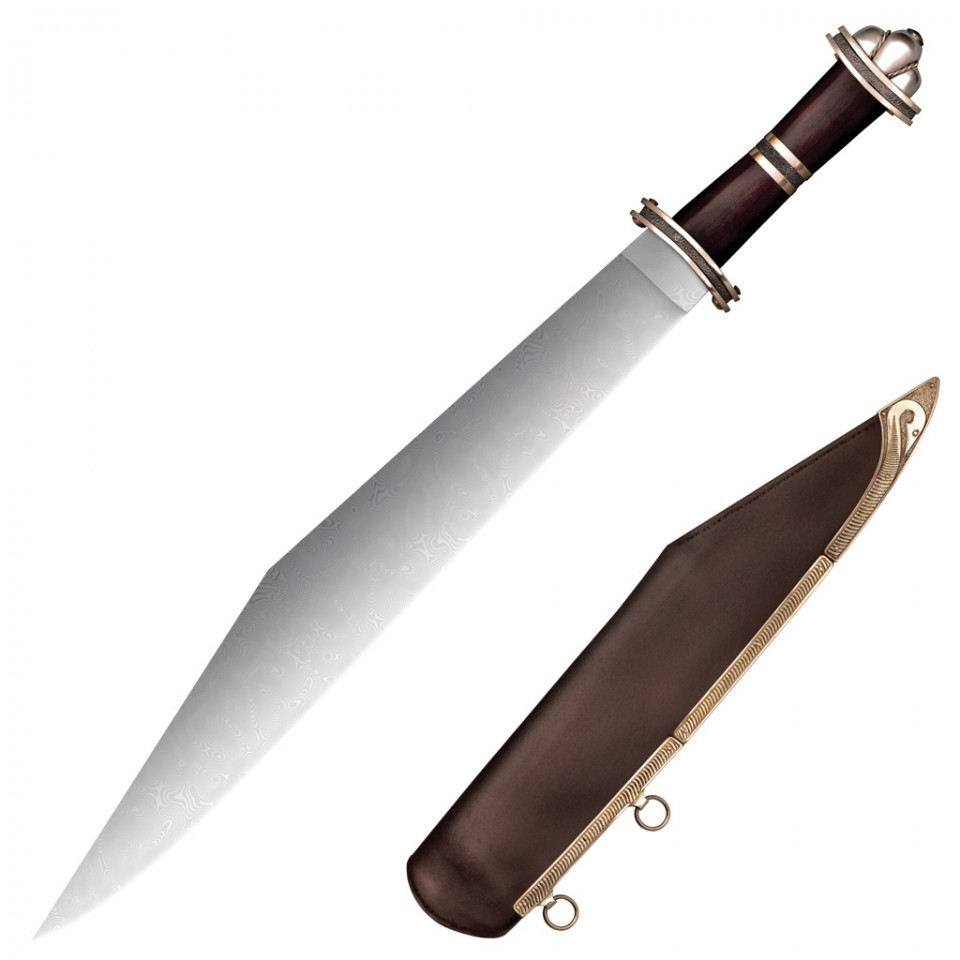
Was it your destiny to be a Viking Earl? If you’ve got warrior blood in your veins, then we have two weapons you’re bound to love. The Damascus Viking Sword and its companion, Long Sax are hand forged from our finest Damascus steel and come fully sharpened and ready for battle. They include some superb appointments, each featuring a beautiful Rosewood grip, and a classically styled guard and pommel made from brass and steel that’s “sandwiched” in the ancient fashion, and polished to a lustrous shine. The sword comes with an impressive wood and leather scabbard that includes a belt loop and a brass throat and chape, that’s accented by deeply embossed decorative elements. The Long Sax comes with an historically correct, thick leather scabbard complete with an embossed brass welt, chape, and carrying rings.
Weight 36.4 oz.
Thickness 7mm
Blade Length 17 1/4"
Handle 6 1/2"
Steel / Material Damascus
Overall 23 3/4"
This is an item from the Cold Steel program in 2019.
€619.00*
Im Außenlager, Langstreckenversand - in 12-14 Tagen bei Dir zu Hause
This website uses cookies to ensure the best experience possible. More information...